Thursday, 12 November 2015

Planning Tasks - Continued: Due Tuesday 24th November

Over the next week and a half you should each be responsible for a pre-production element of your project. You can choose from:
  • Script
  • Storyboard
  • Location shots
  • Casting shots and wardrobe decisions
  • Shot list and shooting schedule (this should be completed last!)

Between you all of these elements will need to be completed on Tuesday, November 24th. This means you have 4 hours of lesson time.

Below are instructions for completing each of these elements correctly. Please ensure you read carefully.

SCRIPT:
Your opening will require a full script (even if you only have minimal dialogue). Your script should be completed in a Word document and uploaded to a site like Scribd so you can embed it into a post. This is a guide to scriptwriting.

There are three bodies of a script: Headings, narrative and dialogue. Each of these has three points to remember.
Headings: 1. Master scene headings which include:
a) Camera location - EXT. (exterior or outside) or INT. (interior or inside)
b) Scene location (LOCAL RACE TRACK)
c) Time (DAY or NIGHT)
2. Secondary scene heading
3. “Special headings” for things such as montages, dream sequences, flashbacks, flash forwards, etc...

Narrative Description: 
1. Action
2. Character and settings (visual)
3. Sounds

Dialogue:
1. The name of the person speaking appears at the top, in CAPS.
2. The actors direction (AKA parenthetical or wryly). Try to avoid these as much as possible. Both the director and actor will appreciate it.
3. The speech.
Putting all this together you should come up with something that looks like this:

INT. BARRY'S BAR - NIGHT
BOBBY is playing darts as he balances on on one foot aims his dart, sips a beer, and eats a handful of peanuts:

                        BOBBY
      (Drunkenly)
   I guess I need a bulls-eye.

As the PHONE RINGS:
           
           BOBBY
   Dammit! I told her not to call me!

BOBBY reaches for the phone and topples over.

STORYBOARDING:
Take your time when creating your storyboard! You will need to include an image of the shot, the type of shot (see short codes below), the type of cut to the next shot, the sound over the shot (e.g. diagetic or non-diagetic) and a brief description of the action. There is a website you can sign up to for a free trial called Storyboard That - it is a great site (especially if you aren't a great artist!).


SHOTS & ANGLES:
Extreme close up - ECU
Close up - CU
Mid-shot - MS
Long Shot - LS
Extreme long shot - ELS
High angle - HA
Low angle - LA

CUTS/TRANSITIONS
Straight cut
Fade to black (or white)
Dissolve 


LOCATION SHOTS:
Consider where you will be filming very carefully. You should have a photograph of each of your locations and a full explanation of what you intend to film there, why you have chosen the location (think mise-en-scene, audience expectations, connotations etc...)

Location: Detached house, MK Village (using exterior only)
Scenes to be filmed: 1, 2 and 10
This location will help to establish the genre of our piece (horror). The house is rundown and interesting shapes make up the exterior - it has a look of a 'haunted' house which should play into the audiences' fears (helping us to establish the desired tone for our opening). As the house is detached it suggests isolation which is fitting with our main character's predicament - she is alone as she is pursued by a killer.

CASTING SHOTS & WARDROBE CHOICES:
Again, these are important decisions which need to be considered carefully. You will require photos of your actors and possible costume choices appropriate to their characters. Remember to consider the representation of your characters. What are you trying to convey and how can this be done visually?

Name of actor: Sally Smith
Role: Polly Kent (First victim of killer)
Reason for casting: Sally looks fresh-faced and innocent. As her character is killed early on in the opening, it is important that a feeling of pity for this character is established as soon as possible. Casting this young and attractive actor will help the audience to immediately feel sorry for her. We will also be appealing to our target demographic with the casting of an actor of a similar age group.


Wardrobe - We want to really emphasize the innocence of this character so that the audience feel the full impact and horror of her murder. The dress pictured on the right has the right balance of innocence and beauty. The short sleeves and frilled front have an almost school girl quality which again would help with establishing the character's vulnerability. We chose white due to the strong connotations of innocence and purity. We felt the dress on the left was a little too provocative and would distract from the victim's innocence.

SHOT LISTS & SHOOTING SCHEDULE
A shot list is a full log of the shots you want to include in your film; essentially it is a checklist filled with finer details that will give your filming a clear sense of direction and purpose.

A shooting schedule is basically a plan of action. It should work in harmony with your shot list but should also serve as a reminder of where you are shooting, what times, what equipment you need (this includes props, costume, cameras etc...) and who is required.

Tuesday, 10 November 2015

Planning Tasks: Due November 17th

Once you have received audience feedback and decided which idea you are going to start developing, you are ready to undertake the planning tasks.


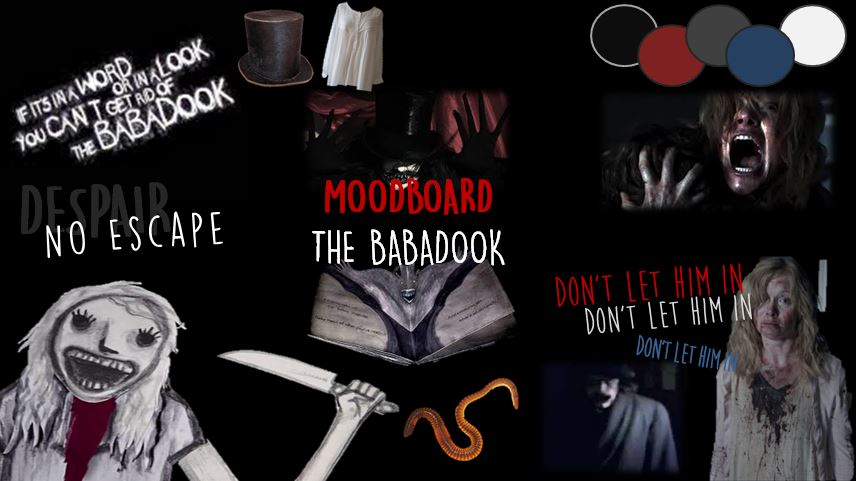
  • The first task you must complete is a moodboard for your film. The purpose of this moodboard is to get you thinking about the overall look and feel of your film. What do you want the finished product to look like? Ensure you consider existing products in the same genre. Consider: colour, imagery, font styles, key words, costume, character types etc...


Here is an example moodboard:


  • If you are aiming for a level 3/4 mark you should also conduct some further research into the CODES AND CONVENTIONS of your chosen sub-genre. Consider the following: what are the typical plots, what colour palettes tend to be used, what font styles are employed, what imagery is typical? To push even further: what about the editing styles and use of camera?
  • NARRATIVE STRUCTURE: Using Todorov's theory, outline the basic narrative of your film (as if you were making the whole thing). Here is an example:

  • TITLE & LOGLINE

Decide on a title and analyse your choice - you should show progression of your ideas (e.g. not just coming up with one title and settling on it - you should have a variety of options) and reasoning behind any decisions (consider conventions of your genre - see slide above).


Writing a logline: You will have to ensure you have communicated with all your group members so that you can all agree on this.


Wednesday, 4 November 2015

Pitching Your Ideas

Task: On your blogs, you must pitch between 2 and 3 ideas for your horror film. The pitch should outline a basic plot with some consideration of sub-genre.


Your pitch should be filmed in the following style:


Once you have added your pitches to your blog, allow members of the class to view them and vote on which they think you should make. You can add a poll function to your blog post (like I have done below). Click HERE for a link with instructions on how this is done.

Out of the film ideas pitched, which would you most like to see being made?

Tuesday, 3 November 2015

Target Audience - Research Task: Due 5th Nov

As outlined in the lesson, you will be undertaking some research into the target audience of horror films. You must produce a case study of an existing horror film. Use the following as guidance for the content. This piece of work should take approximately an hour to produce:


Tuesday, 20 October 2015

Close Analysis - Horror Openings (Due 3rd November)

TASK - Due TUESDAY, 3rd NOVEMBER
Your next research task is to investigate and analyse 5 horror film openings. One of the films you must include is Alfred Hitchcock's classic horror, 'Psycho'. The opening sequence to this film was created by legendary designer, Saul Bass.


Your research should include analysis of 5 horror opening and should address the following points:

Action (this can include dialogue, imagery/iconography etc...)
Print styles (font type, colours, how the credits appear etc...)
Music/sound

Your research should consider how these three elements contribute to the atmosphere created in the opening and how they indicate the genre of the film to the audience. 

Here is an example of how you might set out your work:

And here are some openings you may want to use:


Thursday, 15 October 2015

General Codes and Conventions of Film Openings - Due Nov 3rd

As mentioned, your coursework will consist of you developing your own 2 minute opening sequence of a feature film. In order to do this, it is essential you understand the conventions of film openings so you may apply these to your own work.

TASK:
Undertake research to establish the codes and conventions (elements you usually find) of opening sequences. You should reference a minimum of 6 feature length films. Below are some sequences you may choose to use.

Legally Blonde Opening
Amadeus Opening
Pride & Prejudice Opening
Hulk
Cabin in the Woods
Kung Fu Panda

You may choose additional title sequences - but be careful not to use trailers or ending credits. It must be the first 2 - 4 minutes of a feature film.

As you watch, make notes on the usual elements that are found in an opening sequence. You should consider:

  • CONVENTIONS OF CREDITS - what information is given in the text and what order does it tend to be in (e.g. production company? Actors names? Writers? Director? etc...)
  • NARRATIVE - what is introduced to us in these first few moments? Are we dropped straight into the action? Is the setting of the film established? Are we introduced to main characters?
  • STYLE OF FONTS - is any consideration given to the print style of the fonts? Does it fit with the genre or tone of the film?
  • SOUND - consider how sound is used in an opening. Is music used? If so, how is it used/what purpose does it serve? Is dialogue used? Again, think about how and to what purpose. Is a voice over used?
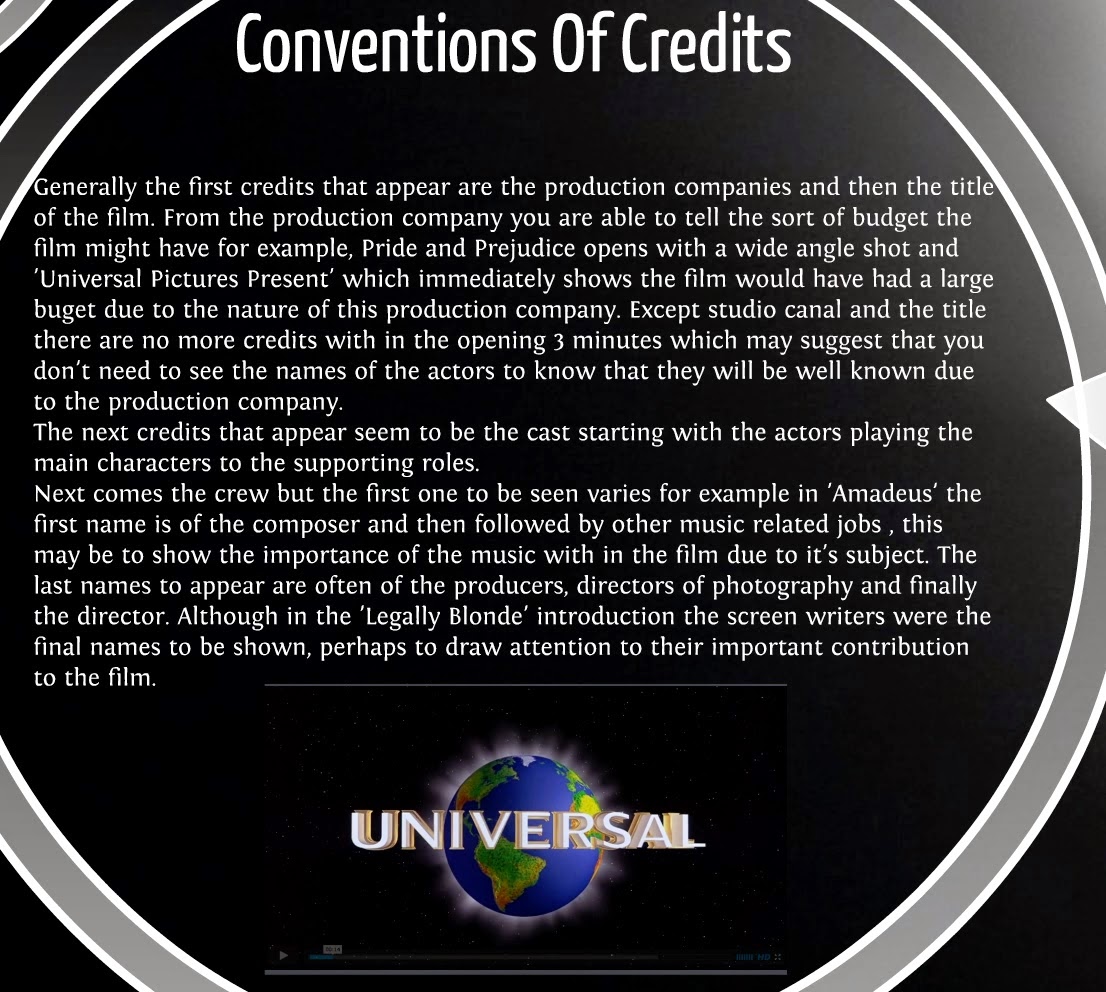
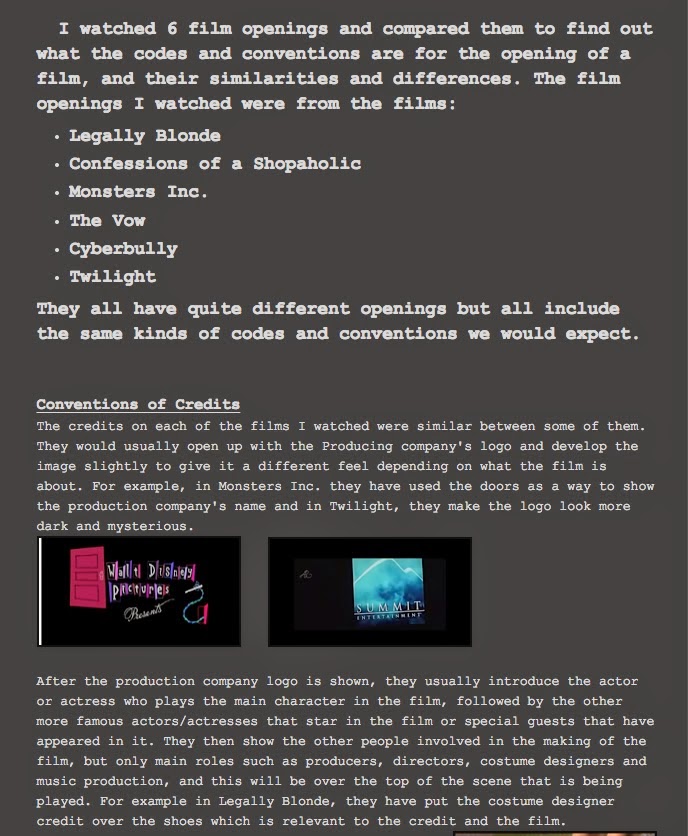
As always, you should be considering carefully how to present your findings. There are many ways you may wish to approach this task - annotated screengrabs from the various films (see below), a Prezi using the 4 areas you have been asked to look at as your headings, a talking heads video (you speaking to camera and using inserts of your screen grabs) etc...

EXAMPLE:

 Having watched a variety of film openings, I have found one common convention to be displaying the production company's logo at the very start of the film. Furthermore, the production company logo appears to be used in such a way as to establish the genre and tone of the film.
 For example, the Dreamworks logo to the left starts with a Chinese style figure jumping on the moon. This turns into the familiar DW logo. This indicates the martial arts aspect of the film - but also an element of fun.
ETC....


OR a PPT with grabs and text boxes:


Here are some screengrabs from last year's students:
This is the opening of a Prezi presentation
This student used screengrabs


Tuesday, 13 October 2015

Iconic Film Openings - the work of Saul Bass (Due 20th Oct)

Research Task - Due on your blog by Tuesday, 20th October

On your blog you must produce a full and accurate account of Saul Bass and his work. You should include supporting images, stills and video clips.

You will need to research the following:
An overview of who Saul Bass is with some general biography details (e.g. D.O.B, nationality, early works etc…)

  • Full details of Saul Bass career and what he was famous for
  • Other film maker’s opinions of Saul Bass and his work
  • Saul Bass’ own views on the importance of film openings
  • Think about the key to his success, summing up his style and your opinions of his work

This post should be fully comprehensive and you are expected to use more than one source for your information. YOU MUST NOT COPY & PASTE FROM ANY SITES – this is part of your coursework, if any sections are copy and pasted you could be accused of plagiarism and disqualified from the course.

Here are some useful websites:

http://www.notcoming.com/saulbass/index2.php

http://www.digitalmediafx.com/Features/saulbass.html

http://saulbass.tv/

http://www.logodesignlove.com/all-about-saul-bass